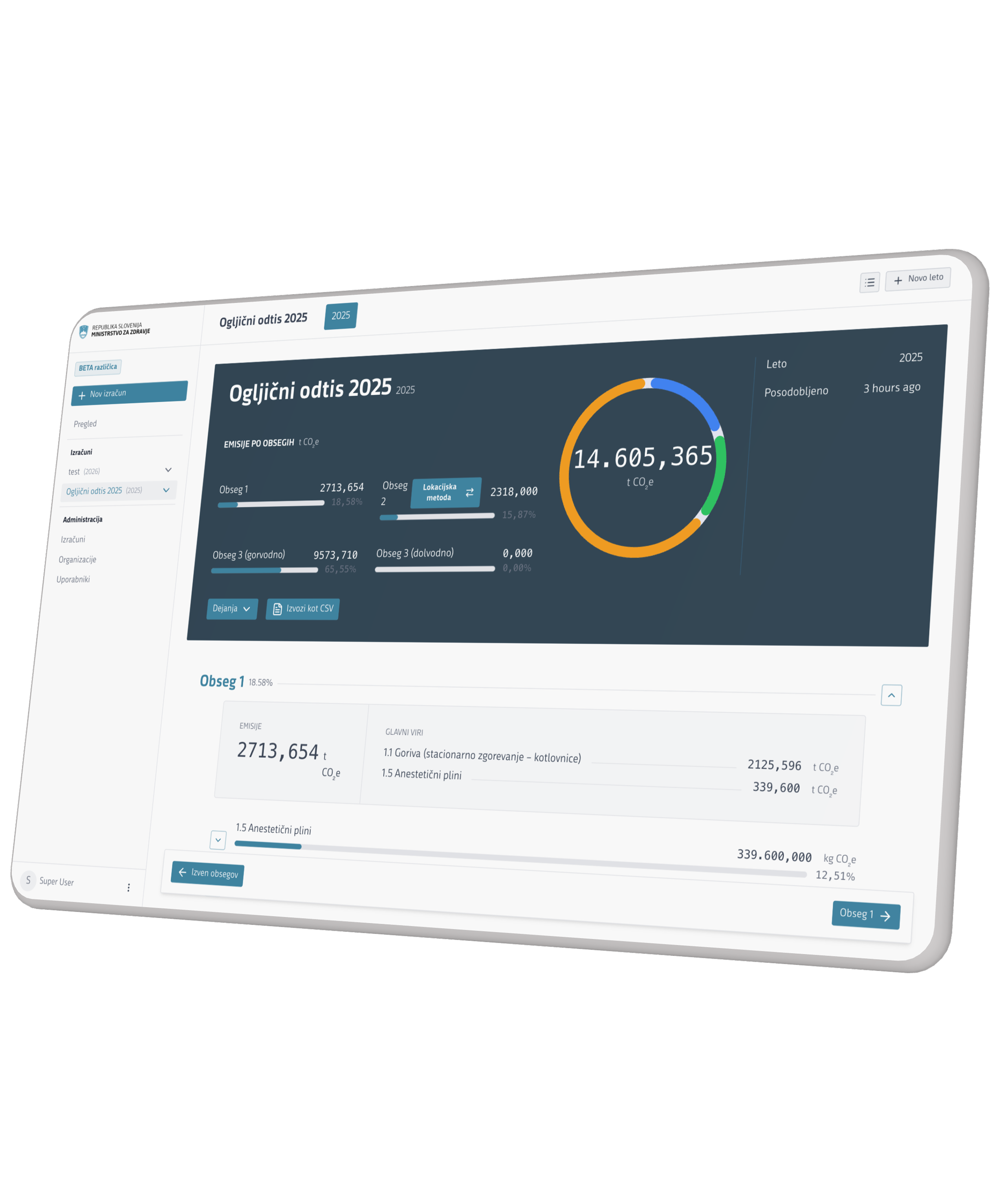
Carbon Accounting Built for Healthcare
Hospitals, community health centres, and pharmacies each need to report their environmental impact, but without a shared tool, results are hard to compare. We designed and developed a web platform that gives every institution the same methodology and the same library of emission factors. Emissions are structured into Scope 1, Scope 2, and upstream and downstream Scope 3. Organisations can still add their own custom factors where needed.
Each calculation covers one or more reporting years. Users can set the reporting boundary, the included scopes, and the Scope 2 method (location-based, market-based, or both), and they can start a new year from the previous one's data. Linked entries between scopes are generated automatically and kept read-only, so the same activity is never counted twice by mistake. Role-based access and row-level database security ensure each organisation only sees and edits its own data.
Nuxt 4
Supabase
PostgreSQL
Docker
System Architecture
Prototype Design
UI Design
Ministry of Health
University of Maribor, Faculty of Chemistry and Chemical Engineering
Benefits
Consistent, Comparable Reporting
One shared methodology and emission factor library make results comparable across institutions nationwide.
Results That Make Sense for Healthcare
Emissions are normalised per bed, hospitalisation, employee, and m², so institutions of different sizes can be fairly compared.
Less Work Every Year
New reporting years can be created from existing data, and cross-scope entries are generated automatically.
Secure by Design
Role-based access and row-level security protect sensitive organisational data.
By the Numbers


